
You shook 40 hands at the conference. Three weeks later, how many are in your pipeline?
For most teams the honest answer is "a handful, maybe." The rest are sitting in a jacket pocket, a tote bag, or a photo roll — slowly going cold. That gap between meeting someone and following up is where most event budgets quietly leak away.
The good news: it's a process problem, not a people problem. With a simple, repeatable system you can capture every lead at the moment you meet them, follow up before they forget you, and prove what the event was actually worth. Here's how.
Why do most event leads never turn into pipeline?
It's rarely one big failure — it's four small ones stacked on top of each other:
- They pile up, then vanish. Paper cards and badges collect in a bag. Most are never entered into anything.
- Manual entry never happens. Nobody re-types 80 cards the night after a show. By the time anyone tries, the context is gone.
- No follow-up, no owner. Without a system, no one knows which leads were contacted — or by whom. Two reps email the same person; ten others get nothing.
- No proof it worked. Travel and booth budgets get spent with no measurable pipeline to show for them, so next year's event spend is a guess.
The cost isn't abstract. A lead that's followed up within 24 hours is far more likely to convert than one you reach a week later — and every cold lead is money you already paid to acquire (flights, booth, time) and then let evaporate. Losing a lead is more expensive than never meeting them, because you've paid the cost without getting the return.
The shift: from collecting cards to managing leads
The fix is to stop thinking about cards and start thinking about a lifecycle. Every introduction should move through four stages:
- Capture — get the contact into one place the moment you meet them.
- Engage — add context and follow up while the conversation is fresh.
- Manage — route the lead to an owner and a pipeline stage.
- Measure — track what converted, so you can prove (and repeat) what worked.
A business card is just the first touch in that lifecycle — useful, but only if everything after it actually happens. Let's walk through each stage.
How should you prepare before an event?
The teams that capture cleanly at the booth are the ones who decided how before they arrived. A few minutes of prep removes the friction that kills capture in a noisy hall:
- Agree on the fields and tags every rep captures. Pick the 2–3 fields (e.g. name, company, email) and the intent tags (hot / warm / "nice to meet") that everyone uses, so the data is consistent enough to act on later.
- Set up your digital card and QR ahead of time. Have your card ready to share in one tap or scan, so swapping details is a single motion instead of a fumble.
- Decide ownership and routing up front. Who owns the leads from this event, and how are they split across the team? Settling this before the show means no lead lands in a no-man's-land afterward.
- Pre-write the follow-up. Draft the template you'll personalize within 24 hours, so the post-event scramble is editing, not writing from scratch.
- Brief the team on one 30-second capture flow. Scan → tag → one-line note. When everyone runs the same motion, nothing slips through because "that wasn't my job."
Prep is the cheapest leverage you have: it costs minutes before the event and saves the leads that would otherwise vanish during it.
What should you do with business cards after a networking event?
Don't let them sit. The single highest-leverage habit is to digitize every card before you leave the venue — or that same evening at the latest, while you still remember who's who.
Practical options, fastest to slowest:
- Scan them with an AI card scanner. Point your phone at a card or badge; modern tools use AI vision to read the name, title, company, email, and phone, then save it as a digital contact in seconds. This is the only approach that scales when you're holding a stack of 50.
- Add a one-line note to each contact immediately — where you met, what they cared about, the next step you promised. This 5-second habit is what turns a name into a real lead.
- Tag by intent (hot / warm / "nice to meet") so your follow-up list writes itself.
Avoid the two losing moves: typing cards into a spreadsheet days later (it won't happen), or doing nothing and "getting to them eventually" (they go cold).
How do you capture leads at a trade show or conference booth?
At a booth you're capturing volume under time pressure, so design for speed:
- Scan badges and cards on the spot, between conversations, instead of stockpiling them for later.
- Make sharing two-way. Share your own digital card via a QR code or a tap, and capture theirs in the same motion — no app required on their side.
- Standardize what you collect. Agree as a team on the 2–3 fields and tags every rep captures, so the data is clean enough to act on.
- Keep a live count. Seeing "62 leads captured today" on a shared view keeps the team motivated and surfaces who needs help — progress you can see drives more of it.
The goal is simple: by the time you tear down the booth, every conversation already exists as a structured lead, not a rubber-banded pile.
How do you follow up so leads don't go cold?
Speed and relevance win. A few rules that consistently outperform a generic blast:
- Reach out within 24 hours. You're still a fresh memory; wait a week and you're a stranger.
- Reference the conversation. "Great talking about your Q3 rollout" beats "Nice to meet you at the show." Those notes you captured are what make this possible.
- Assign one owner per lead so nothing is double-touched or dropped.
- Set the next step automatically — a reminder, a task, a sequence — so follow-up isn't dependent on memory.
If your capture step saved context and tags, this step is almost effortless: you already know who's hot, what they wanted, and who owns them.
How do you manage and route leads across a team?
Capture and follow-up are individual habits; management is where teams win or lose:
- Put every lead in a shared pipeline with clear stages (e.g. Lead → Contacted → Qualified → Won) so anyone can see status at a glance.
- Attribute leads to whoever captured them, even if the deal is later reassigned — people work harder when their sourcing is visible and credited.
- Sync to your CRM automatically, with de-duplication, so reps aren't doing data entry and your CRM isn't filling up with duplicates.
- Make it the default path, not extra work. If logging a lead is harder than ignoring it, it won't happen — the easiest option always wins.
How do you measure the ROI of an event?
If you can't measure it, you can't defend the budget. Track, at minimum:
- Leads captured (and by whom).
- Follow-up rate — what share actually got contacted.
- Conversion to opportunity / customer.
- Pipeline and revenue sourced from the event, against its all-in cost.
Once "the conference" becomes a number on a dashboard instead of a vibe, two things happen: you can prove the wins, and you can cut what doesn't work. Both make next year's events better.
What this looks like in practice
Picture a three-person team working a 200-booth expo over two days. Here's the difference the system makes.
The old way: they come home with a tote bag of ~180 business cards. In the weeks after, someone types maybe 30 into the CRM before the day job takes over. A few get a generic "great to meet you" email. By the time anyone asks "did the expo pay off?", nobody can say which deals — if any — came from it.
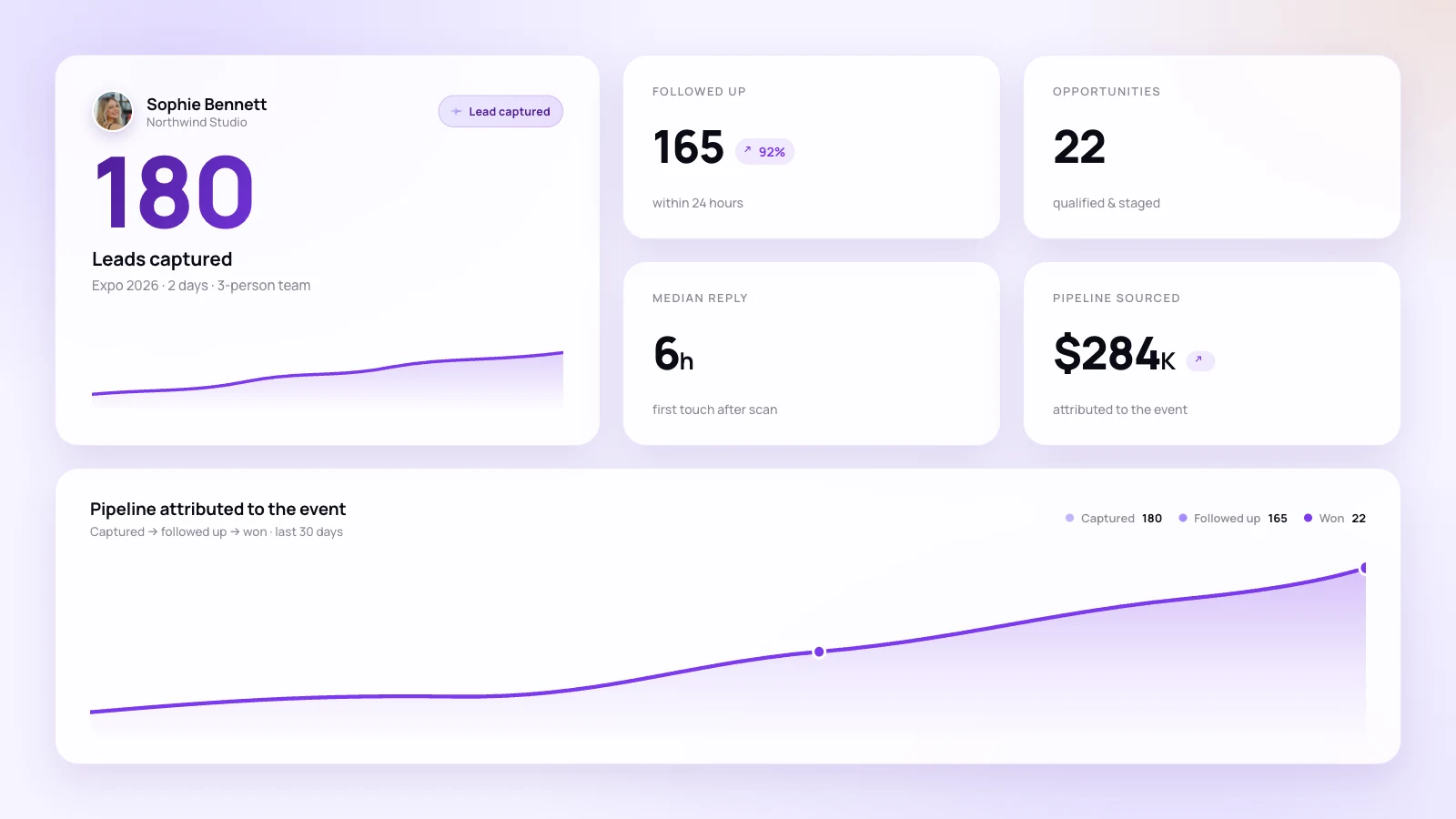
With a capture-first system: they agree on four fields and three tags before they go. On the floor, every badge gets scanned between conversations — 180 leads, captured on the spot, visible as a live count on a shared view. Each evening they add a one-line note and a hot/warm tag while the conversations are fresh. Within 24 hours, the ~40 hot leads get a personal, context-aware follow-up from whoever owns them; the warm ones drop into a sequence. A week later the pipeline tells the story: 180 captured → 165 followed up → 22 opportunities → a handful of deals, measured against the event's all-in cost.
Same event, same conversations. The only difference is that the second team built a path for every lead to travel — so none of them quietly disappeared.
The 6-step event lead checklist
Copy this for your next event:
- ☐ Before: agree on the fields + tags every rep captures.
- ☐ At the event: scan every badge/card on the spot; share your card via QR/tap.
- ☐ Same day: add a one-line note + intent tag to each lead.
- ☐ Within 24h: assign an owner and send a personal, context-aware follow-up.
- ☐ Week 1: move each lead through pipeline stages; sync to CRM.
- ☐ After: review leads captured → followed up → converted, vs event cost.
Where a tool helps (and where it doesn't)
You can run this system with a notebook and discipline — but at volume, a dedicated tool removes the steps that usually break. A lead-capture platform like Lynqu is built around exactly this lifecycle: AI scanning to capture any badge or card, a contact hub to tag and note, a shared pipeline with capture-based attribution, and automatic CRM sync — so the leads you meet become tracked, followed-up pipeline instead of a pile of cards. You can start for free and bring a card you already use.
To be clear, no tool follows up for you or replaces a good conversation. What it does is make sure the lead is still there, in context, when you're ready to act — which is the part teams most often get wrong.
FAQ
What's the best way to capture leads at an event?
Capture each contact the moment you meet them — scan the badge or card with an AI scanner and add a quick note — rather than collecting cards to process later. On-the-spot capture is the only method that survives a busy booth.
What should I do with business cards after a networking event?
Digitize them the same day while you still remember the conversations: scan each card into a contact app, add a one-line note and an intent tag, then follow up within 24 hours. Don't leave them for a "spreadsheet later" that never happens.
How fast should I follow up with event leads?
Within 24 hours. Follow-up speed is one of the biggest predictors of whether a lead converts, because you're still a fresh, specific memory rather than a forgotten stranger.
How do I measure whether an event was worth it?
Track leads captured, follow-up rate, conversion to opportunity, and pipeline/revenue sourced — then compare that to the event's all-in cost. Attribute leads to the rep who captured them for clean team metrics.
Do I need an app to share or capture a card?
No. A good digital card is shared via a QR code or tap and opens in any browser — the person receiving it doesn't need to install anything. You only need a capture tool on your side.