
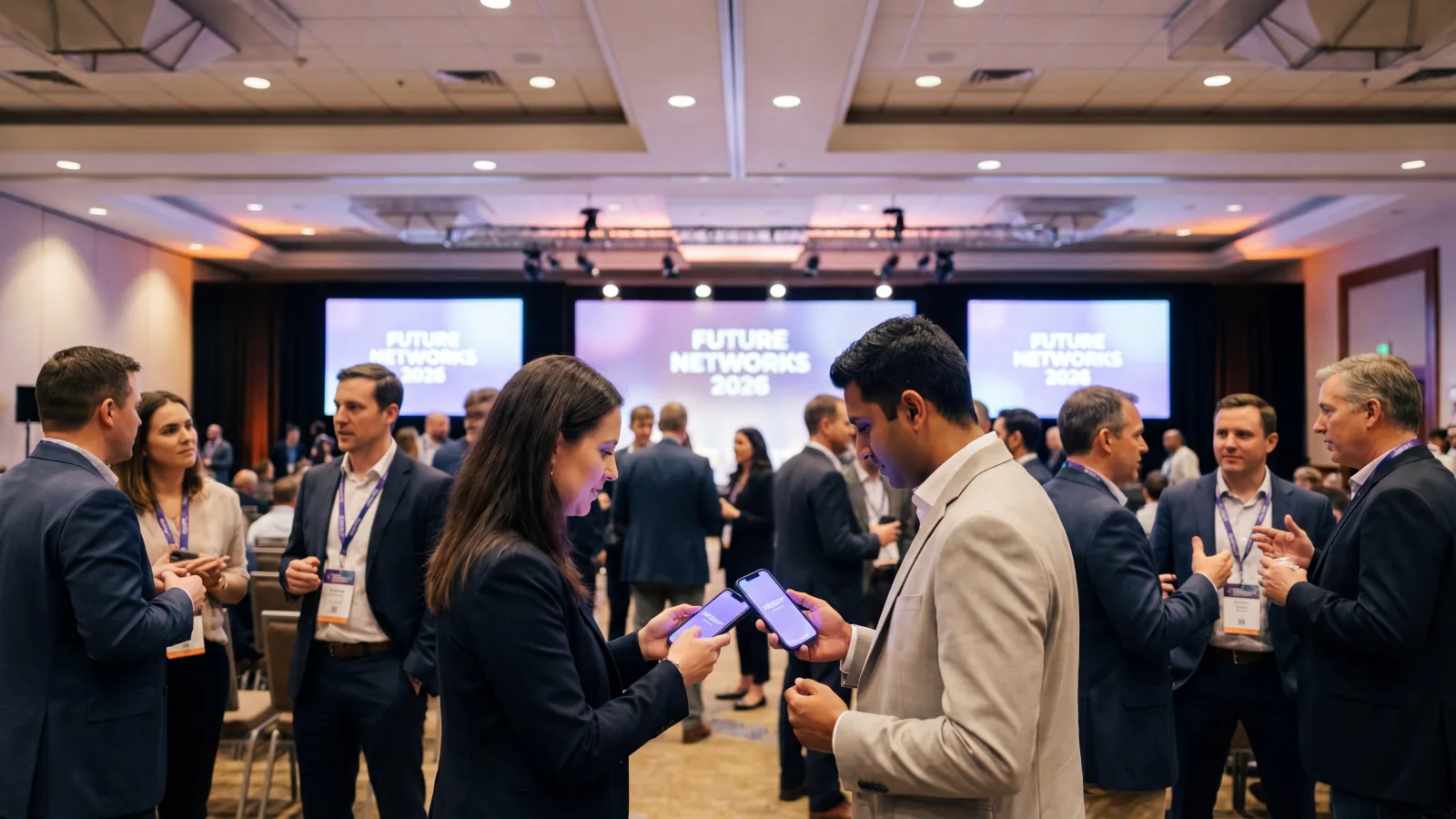
The way professionals network at conferences has changed more in the last five years than in the previous fifty. Paper cards have largely been replaced by phone taps and QR scans. Hybrid event formats have created entirely new categories of attendee. AI-powered contact capture has compressed the work of post-event follow-up from days to minutes. The fundamentals of how relationships actually form remain the same, but the tools and the rhythm are different.
This guide is the practical 2026 version of the conference networking playbook. It assumes you are an experienced professional, that your time at events is expensive, and that you measure outcomes more than attendance. It covers the four phases of any productive event—preparation, the conference itself, immediate follow-up, and long-term cultivation—and the specific tactics that distinguish high-yield networking from busy attendance.
The Pre-Conference Phase: Where Most ROI Is Decided
The single most underrated insight about conference networking is that the work that determines outcomes happens before the event starts, not during it. The professionals who consistently produce the most value from conferences arrive with a list of specific people to meet, a clear sense of what they want to accomplish, and meetings already scheduled.
Two to Four Weeks Out: Define the Goal
Most conferences offer too many possible activities for any one attendee to do them all well. The choice of what to optimize for shapes everything that follows.
The four primary networking goals at any conference:
- Pipeline generation. Meet new prospects who could become customers.
- Existing relationship deepening. Spend meaningful time with current customers, partners, or peers you already know but rarely see.
- Industry intelligence. Understand what is happening across your category through hallway conversations and unscripted interactions.
- Personal brand building. Get visible in your industry through speaking, panel presence, or active hallway participation.
Most professionals try to do all four and accomplish none of them well. Pick one as the primary goal, and let it shape your itinerary. The metric for success at the end of the conference should map directly to that goal.
Research the Attendee List
Most modern conferences publish at least a partial attendee list, often including roles and companies. The conference app or platform usually has a search function. Spend an hour going through it.
You are looking for three groups:
- The 5 to 10 people you most want to meet. Specific names. People whose work, role, or company maps to your primary goal.
- The 10 to 20 people you would benefit from meeting if the opportunity arises. Less critical, but worth being prepared for.
- The 5 to 10 existing connections you should make sure to see. People you already know who will be there.
Without this list, your conference becomes random. With it, you can recognize the right people in any context and you have a default agenda you can return to whenever a session is unfocused or a hallway conversation is winding down.
Reach Out Before the Event
For the top tier of your list, reach out at least two weeks in advance. The note should be short and specific:
“Hi [Name], I see you will be at [Conference] in [City]. I’d love 20 minutes to compare notes on [specific topic]—[reason this is interesting]. Are you free for a coffee on the morning of day two?”
Specificity matters. A vague “love to connect” ask gets a vague non-response. A 20-minute slot for coffee with a clear topic is easy to say yes to.
Industry research from event-marketing platforms and post-event attendee surveys consistently finds that attendees who pre-book at least a handful of meetings before a conference report substantially higher satisfaction with the event and meaningfully higher conversion of those meetings into ongoing relationships, compared to attendees who only network on the floor.
Prepare Your Digital Card
This is the part that most people skip and that turns out to matter more than expected. Before the event:
- Update your headshot if it is more than a year old.
- Update your title and company. If anything has changed since the last conference.
- Adjust your bio to be specific to the audience at this event. A consultant attending a fintech conference should mention fintech work; the same consultant attending a media conference should mention media work.
- Add a calendar booking link. The friction between “great to meet you” and “here’s a time we can talk further” should be one tap.
- Test the share flow. Tap your card to a colleague’s phone. Scan the QR. Make sure both work, that the card loads quickly, and that the call to action is clear.
A well-configured digital business card on a phone you have charged is more useful than 200 paper cards. The recipient saves the contact directly, no retyping, no “I’ll send you my information later.” (For the practical NFC-vs-QR sharing decision, see NFC vs QR: which is right for your business card.)
Prepare a 30-Second Self-Introduction
Have a tight version of who you are and what you do, calibrated to the audience at this conference. Two sentences. The version you would say to someone who asked “so what do you do?” in a coffee line. The point is not to memorize a script; the point is to have thought about it once before the event so you do not have to invent it 40 times during it.
The Conference Itself: Tactics That Compound
The most important shift in conference networking is moving from passive attendance to active orchestration. The tactics below are the ones that distinguish productive attendees from busy ones.
Skip Some Sessions
Counterintuitive but well-supported. The hallway track—the conversations that happen between sessions—is consistently more valuable for networking than the sessions themselves, particularly at conferences with strong online recordings. Senior-attendee surveys across major B2B events repeatedly find that the majority of attendees rank hallway-track conversations as their highest-value time, well above scheduled sessions.
The implication: do not feel guilty about skipping sessions if the hallway is alive. The conference will record the session you missed. It will not record the conversation you skipped to attend it.
Master the Booth Strategy (If Your Goal Is Pipeline)
For sales-driven attendees, booth interactions are still where the highest volume of new contacts originates. The booth tactics that produce the most yield:
- Talk track that qualifies in 60 seconds. Every booth interaction should answer three questions quickly: who is this person, are they a fit, what is the right next step. Long demos are usually a mistake at booths; they prevent the rep from talking to the next person.
- Capture every interaction, not just the good ones. Even attendees who do not seem like a fit may be relevant later. The cost of capturing a contact via a digital business card share is zero. The cost of missing a future fit is non-trivial.
- Annotate immediately. A one-sentence note on each captured contact (“Looking at platform consolidation, $3M+ ARR, decision Q3”) is the difference between a useful contact and a forgotten one. Most modern card platforms allow this annotation as part of the capture flow.
- End conversations cleanly. “That’s really helpful context—let me get your contact and I’ll send a more detailed walkthrough on Tuesday.” Close the loop, capture, and move on.
Plan the Hallway, Don’t Just Wander It
The hallway track sounds spontaneous but is most effective when partly orchestrated. Tactics:
- Pick three high-traffic locations where you will spend at least 30 minutes each day, visibly available for conversation. Coffee stations, registration areas, and the entrance to the main keynote are reliable choices.
- Be visible. Stand near the edges of conversations, not deep in your phone. The smaller and more casual the conversation cluster, the easier it is to join.
- Practice the open. “What brought you to this session?” or “Who are you hoping to meet here?” opens conversations more reliably than “What do you do?”
- Trade time for depth. A 20-minute conversation with one well-matched person is more valuable than 10 two-minute exchanges with random ones.
The Strategic Dinner
For senior attendees, the most concentrated networking value at a conference often happens at curated dinners—groups of 6 to 12 people, organized either by the conference itself or by an attendee with the social authority to convene one.
If you can host a dinner, do. The pattern is:
- Identify a topic or theme that unites a small group of senior peers.
- Reach out two to three weeks before the conference with a specific invitation.
- Book a quiet restaurant near the venue.
- Set a loose discussion topic for the table to anchor conversation.
The host of a dinner gets disproportionate goodwill and visibility for relatively modest effort. The attendees of a well-run dinner remember it more vividly than any session at the conference.
Use the Conference App, but Sparingly
Most major conferences have an app with messaging, scheduling, and attendee search. Use the search function to locate people. Use the scheduling to book pre-event meetings. Avoid using the messaging for cold outreach during the event itself—most attendees ignore in-app messages and are far more responsive to in-person approaches or warm pre-event email outreach.
Capture the Context, Not Just the Card
The single highest-leverage habit at any conference is the discipline of writing a one-sentence note about each conversation immediately after it ends. Where you met, what they care about, what you promised to send. This is the difference between coming home with 80 captured contacts you can act on and 80 captured contacts you cannot remember.
Modern lead-capture flows allow this annotation directly on the captured contact. The note travels with the contact into the CRM, ready for the follow-up that you have not yet had time to write. The framework for tracking what these notes eventually produce is in how to measure networking ROI.
The Immediate Follow-Up Window: 24 to 72 Hours
If the conference work is the seed, the 72 hours after it is the watering. Most relationships either consolidate or dissolve in this window.
The First Email, Within 24 Hours
The single most leveraged action of the entire conference cycle. A short, specific note to each meaningful contact:
“Hi [Name], really enjoyed our conversation about [specific topic] at [Conference] yesterday. As promised, I’ve attached [the case study, the article, the deck]. Happy to keep the conversation going—here’s my calendar if a follow-up call would be useful: [link].”
Three rules:
- Specific, not generic. Reference the actual conversation. The recipient should know immediately that you remember them.
- One concrete next step. A document attached, a calendar link, a specific request. Vague “let’s stay in touch” emails get vague non-responses.
- Within 24 hours. The follow-up curve drops sharply after the first day. Industry data on post-event response rates consistently shows that follow-ups within 24 hours generate dramatically higher response rates than identical content sent four days later.
Send LinkedIn Connection Requests
Send a LinkedIn connection request to every meaningful contact within 48 hours, with a one-line personal note referencing the conversation. The connection request is a low-cost durable record of the relationship that survives email-address changes, job changes, and forgotten phone numbers.
Update Your CRM
Every captured contact should land in the CRM within 72 hours, tagged with the conference as the source. The faster this happens, the more accurate the entries will be. Manual recall after a week produces incomplete and inaccurate records.
The reason for tagging the source is not bureaucratic. It is so that, six months from now, when one of these contacts becomes pipeline, you can see clearly what the conference produced. Without source tagging, the conference’s ROI becomes invisible.
Schedule the Day Two Follow-Ups
For the highest-priority contacts, schedule a substantive follow-up touch for one to two weeks later. A second email, a phone call, a relevant article forwarded with context, an invitation to a webinar. The pattern matters more than the format: it signals that the relationship is real, not a single transactional encounter.
The Long-Term Cultivation Phase
Most conference relationships either compound into something valuable or fade entirely. Which outcome you get is determined by the patterns you maintain in the months after the event.
The 30-Day Touch
One month after the conference, send a substantive update to your top tier of contacts. Not promotional. Useful. A relevant industry development, a question you are working through, a recommendation tailored to their role. The 30-day touch keeps the relationship live without requiring it to have a transactional purpose.
The Quarterly Check-In
For relationships you want to maintain over years, the quarterly check-in is the minimum cadence that prevents drift. A short note, no agenda, with one piece of substance. The professionals with the strongest networks tend to maintain rolling quarterly contact with 50 to 100 people, on a calendar they actively manage.
The Annual Reconnection
Most contacts will only stay alive if you reconnect at least once a year. The simplest framework: when you are about to attend the same conference again, reach out to the people you met there last time. The shared context makes the message easy to write and easy to receive.
The 2026 Trends That Are Changing the Game
A few specific shifts that distinguish today’s conference networking from five years ago.
Hybrid Events Have Created Two-Tier Audiences
Many major conferences in 2026 have substantial virtual audiences alongside in-person attendees. Networking with virtual attendees is harder—there is no hallway, no eye contact, no spontaneous overlap. But the virtual audience is often larger and includes people who could not justify the in-person trip. The most sophisticated attendees treat in-person and virtual networking as separate tracks with different tactics. For virtual-only counterparts: schedule explicit virtual meetings, attend virtual breakouts, use the conference platform’s networking features more aggressively than you would in person.
AI-Powered Lead Capture Has Made Friction Disappear
The work of capturing, transcribing, and following up on conference contacts used to take days. With modern AI scanning and digital business card capture, it can be done in real time. The implication is not that you have to capture more contacts; it is that the bar for what counts as “captured” has risen. A contact you cannot follow up with within 24 hours is barely captured at all. (For the deeper technical context, see how AI is changing business card scanning.)
QR-First Conference Materials
Most major conferences in 2026 have moved to QR-first session materials, registration, and even badge exchange. Bring a phone with the camera ready and a charging plan; the days of paper handouts are largely over.
Pre-Event Networking Platforms
Many conferences now offer dedicated pre-event networking platforms—essentially a structured introduction system that lets attendees identify and message each other in the weeks before the event. These platforms are most useful for pre-booking meetings and least useful for substantive conversation. Treat them as a scheduling tool, not a relationship tool.
The End of Mass Email Follow-Up
Mass automated post-event email sequences have a poor reputation now. The combination of buyer fatigue and improved spam detection means that 200 identical follow-up emails produce worse results than 20 individually written ones. The math has flipped: more contacts, less personalization, lower yield.
Common Mistakes to Avoid
Treating the Conference as a Vacation
The conferences with the highest networking yield are the ones the attendee treated as work, not as a perk. Attending sessions casually, networking when convenient, and skipping follow-up is the surest way to make the event a sunk cost.
Over-Investing in the Wrong Conferences
Not all conferences produce equal value. Some are heavy on attendance but light on the people you actually want to meet. Track the source-attribution of pipeline by event over time. After one or two cycles, you will know which conferences justify their cost and which to drop.
Networking Only With Peers
It is easy to gravitate toward people who do exactly what you do. Diversity in your conference network—people upstream, downstream, and adjacent to your work—produces more durable value than density of same-role peers.
Forgetting the Existing Network
Conferences are an unusual concentration of people you already know but rarely see. Reserving deliberate time for existing relationships often produces more value than chasing new ones. The strongest networks compound through depth, not just breadth.
Skipping the Follow-Up Because You Are Tired
The single most common reason conference networking fails to produce results. The 24-hour follow-up window closes during the post-conference exhaustion when the rep most wants to take a day off. Discipline here is what separates the conferences that produce value from the ones that produce only memories.
Solo Attendance vs Team Coordination
Different tactics work for different attendance modes.
Solo Attendance
The advantages of attending alone: nothing to coordinate, full schedule flexibility, no dependence on a colleague’s preferences. The disadvantages: more lonely time during meals, less leverage on booth coverage, no informal debriefs in the evening.
The solo playbook: be more aggressive about pre-booked meetings (you have no fallback social plan), more intentional about hosting at least one small gathering, and more disciplined about evening follow-up (no colleagues to drag you to dinner you should be skipping).
Team Coordination
For teams attending together, the multiplier is real if coordinated well. The patterns that work:
- Divide the territory. Different team members focus on different sessions, different tracks, different geographies.
- Use a shared capture system. Every contact captured by any team member should land in the same shared system, so the team has a unified post-event view.
- Brief and debrief. A 20-minute team meeting at the start of each conference day to align on goals, and a 20-minute debrief at the end to share what each member learned.
- Coordinate hand-offs. When one team member meets a contact better suited to another’s portfolio, the warm handoff during the conference is dramatically more effective than a cold introduction afterward.
Most of the patterns above are sales-team patterns specifically; the deeper playbook lives in 5 ways sales teams close more deals with digital business cards.
The Annual Calendar
For senior professionals, conference networking works best as a deliberate annual calendar rather than a series of one-off decisions.
The principles:
- Pick 3 to 5 conferences per year that consistently produce value, and commit to them. The marginal value of a sixth or seventh is usually low.
- Mix conference types. Industry conferences for pipeline, peer conferences for relationships, broader cross-industry conferences for serendipity.
- Schedule recovery. Conferences are exhausting, and back-to-back events produce dropoff in follow-up quality. Build in at least a week between events to consolidate the previous one.
- Review annually. Once a year, look at what each conference produced (pipeline, hires, partnerships, intelligence) and adjust the next year’s calendar accordingly.
The Conference Calendar That Pays Off
Conference networking in 2026 is more measurable, more efficient, and more competitive than it has ever been. The tools have improved dramatically. The bar for what counts as a productive conference has risen with them.
The professionals who consistently produce the most value follow a small set of habits: they prepare specifically before the event, they show up with goals rather than vibes, they capture context alongside contact details, and they are religious about the 24-hour follow-up window. None of these habits is exotic. All of them compound, and the difference between attendees who follow them and attendees who do not is often an order of magnitude in eventual outcome.
If you are about to attend a conference, the most leveraged thing you can do is treat the next 30 minutes as part of the conference itself. Build the list. Send the pre-event outreach. Update your card. Test the share flow. Then go to the event with the work already half-done—and let the people you meet experience the difference.