Sales is, at its core, a follow-up game. The single biggest determinant of whether a meeting turns into a deal is what happens in the 48 hours after the meeting ends. The well-known Lead Response Management Study by Dr. James Oldroyd—widely cited across sales operations literature—found that the odds of qualifying a lead drop by roughly an order of magnitude when first contact happens after the first hour, and by another order of magnitude after a day.
Yet the moment of capture—the seconds when a sales rep meets a prospect, exchanges contact details, and forms a first impression—is still where most sales teams quietly lose their pipeline. Cards are forgotten in suit pockets. Names are misspelled into the CRM. Email follow-ups happen three days late, by which time the prospect has met four other vendors at the same event.
Digital business cards have become a quietly important tool for closing this gap. Not because they are new, but because the 2026 generation finally does what previous generations promised: capture the lead in real time, sync it directly into the systems where the sales team actually works, and create a first impression that builds rather than breaks credibility.
Here are the five concrete ways high-performing sales teams are using digital business cards today.
1. Trade Show and Conference Lead Capture That Reaches the CRM Same-Day
Conferences and trade shows remain one of the highest-yielding lead sources in B2B. The Center for Exhibition Industry Research (CEIR) consistently finds that 81% of attendees have buying authority and that closing a single deal sourced from an event covers, on average, 4 to 8 times the per-attendee cost of being there.
The yield is wasted, though, when the leads do not get actioned. The classic failure pattern: a rep collects 200 cards over three days, returns to the office exhausted, and spends two weeks of evenings retyping them into Salesforce. By the time the leads land in the CRM, the prospect’s memory of the booth conversation has faded. Industry surveys of trade-show follow-up consistently find that fewer than a third of event leads are contacted within a week, and barely one in ten within the critical first 24 hours.
The Digital Card Workflow
The pattern that produces consistent same-day follow-up looks like this:
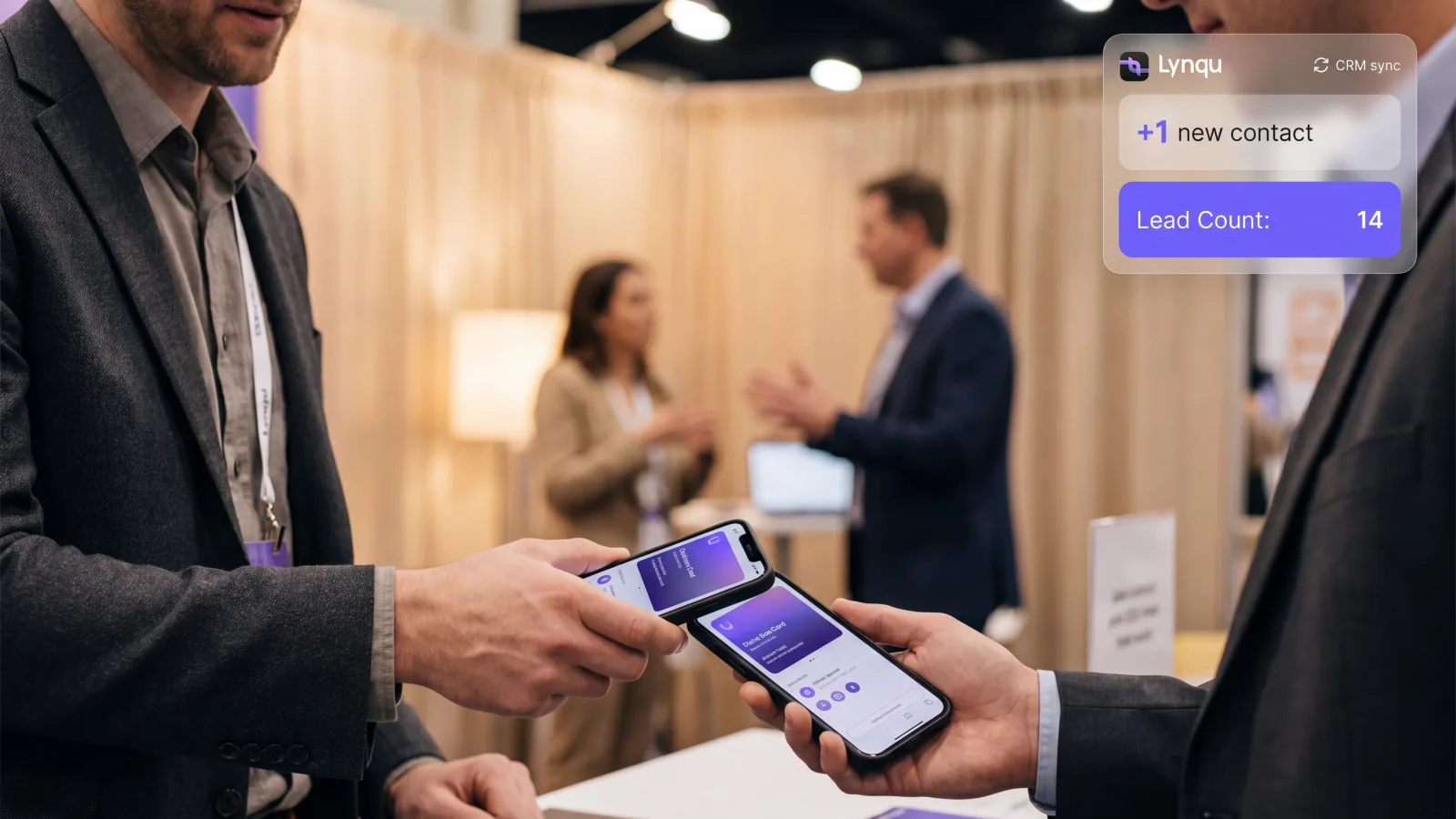
- Rep shares their digital card by tap or QR at the start of every conversation. The prospect lands on the rep’s profile, hits a “Save Contact” or “Save and Connect” button, and their information is captured back into the system.
- Inbound capture replaces outbound retyping. Instead of the rep collecting cards and entering them later, the prospect enters their own information through the contact form on the rep’s digital card. The data is structured, accurate, and complete from the start.
- Automatic CRM sync. Each captured lead syncs directly into the team’s CRM with the event tagged as the source. By the end of the booth shift, every lead is searchable, assignable, and ready for follow-up.
- Same-evening follow-up. A simple templated “great to meet you” email sent within four hours of the conversation, while the prospect can still picture the rep’s face, dramatically outperforms identical messages sent days later.
Teams that have made this switch typically report a 2x to 3x increase in same-week follow-up rates and a measurable lift in lead-to-meeting conversion. The mechanism is not complicated—they are simply doing what they always intended to do, faster, because the friction is gone.
2. Field Sales Outreach With a First Impression That Says “Modern”
For field sales reps—outside reps in industries like enterprise software, medical devices, financial services, and industrial supply—the first 30 seconds of an in-person meeting carry disproportionate weight. The buyer is consciously or subconsciously asking: does this person and this company look credible?
A paper card hands the buyer a small physical object that they will probably lose by Friday. A polished digital business card, tapped to the buyer’s phone or scanned from the rep’s screen, hands the buyer a working profile that lives in their device, complete with photo, role, contact buttons, calendar booking link, and links to whatever proof the rep wants to surface (case studies, demo video, testimonials).
What Buyers Actually Notice
Buyer surveys from HubSpot’s State of Sales reporting consistently show that the majority of B2B buyers form their initial credibility judgment of a vendor within the first five minutes, and that most of those judgments are based on cues that are nominally not about the product—professionalism, polish, and ease of working with the rep. A digital business card is one of those cues.
The cues that buyers consistently report noticing:
- The transition from card to next action is one tap. “Save contact,” “book a meeting,” or “send a message” is sitting right there on the card profile. There is no follow-up email gap during which the rep’s name fades from memory.
- The rep is using the same tools the buyer’s own company uses. Buyers are themselves senior executives or technical leaders. They notice when a vendor has invested in a polished, modern toolchain, because they can see it in 30 seconds.
- The card represents the company brand consistently. If every rep on a sales team has the same brand kit—same color palette, same logo treatment, same typography—the buyer perceives a coherent organization, not a collection of individuals.
For teams using a B2B-tier card platform, the brand consistency is enforced automatically. Each rep’s card inherits the company brand kit, so a prospect meeting three different reps from the same vendor sees three coordinated visual identities rather than three random LinkedIn profile screenshots. (For the full playbook, see building a brand kit for your whole team.)
3. Account-Based Selling With Account-Specific Touchpoints
Account-based selling (ABS) inverts the traditional inbound funnel. Instead of casting wide and filtering, ABS teams pick a target list of named accounts and pursue each one with coordinated, personalized outreach. The unit of measurement is not lead volume but penetration: how deeply has the team engaged with the named account.
For ABS teams, every touchpoint is a chance to either build or burn perceived effort. A digital business card with an account-specific landing experience is one of the highest-leverage touchpoints available.
What Account-Specific Cards Look Like in Practice
The pattern most often used by enterprise reps:
- A primary digital business card for general use.
- A small set of variant cards for top-tier named accounts, each with a personalized greeting, a relevant case study, and a calendar link routed to the correct meeting type.
- The variant card’s URL or QR is shared in proposal documents, executive briefing materials, and post-meeting follow-up emails.
The effect is subtle but cumulative. The buyer at the named account sees a coordinated, deliberate experience that suggests the vendor has thought about them, not about lead volume. Combined with content that is also account-specific, the perceived effort gap between this vendor and a generic mass-outreach competitor becomes large.
Forrester research on enterprise buying journeys consistently finds that perceived seller effort is one of the top three predictors of which vendor wins a competitive deal. The card itself is not what wins the deal—but it is one of the cheapest, most visible signals of seller seriousness available.
4. Email Signature and Async Follow-Up That Compounds Over Time
The least-discussed but possibly highest-volume use case for digital business cards is the email signature. A typical sales rep sends 60 to 120 outbound emails per week, plus internal messages, plus replies. Over a year, that is between 5,000 and 10,000 message touches—every one of which carries the rep’s signature.
A traditional plain-text email signature is invisible. The recipient’s eye skips over it. A signature with a polished embedded card preview, a calendar link, and a single “save contact” CTA does the opposite: it captures the conversation that is already happening and offers the next step.
The Quiet Conversion Mechanism
The math here is unobtrusive but compounding:
- If 1% of the rep’s annual email recipients click the signature CTA, that is 50 to 100 incremental engagements per year.
- If 10% of those convert into a saved contact or booked meeting, that is 5 to 10 additional pipeline opportunities per rep, per year, that did not require any incremental work.
- Across a 50-rep team, that is 250 to 500 incremental opportunities per year sourced from a touchpoint that already existed.
This is the kind of outcome that does not show up in any dashboard until you specifically attribute it. The reps and managers who notice it tend to push hard for company-wide adoption, because the per-rep cost is essentially zero and the marginal return is real.
A modern email signature with an embedded card preview can be generated from the same profile, so any update—new title, new role, new direct line—flows through to thousands of historical emails the next time the recipient opens them.
5. Referral Generation: Making Sharing Effortless
Referrals are the most efficient lead source by a wide margin. Multiple B2B referral benchmarks consistently find that referred leads close at roughly 4x the rate of cold leads and have noticeably shorter sales cycles. Yet referrals also have the worst tracking story of any channel: most companies do not know who their best referrers are because the asking is informal and the attribution is fuzzy.
Digital business cards quietly improve referrals on two dimensions: they make the share itself easier, and they make attribution measurable.
Making Sharing Frictionless
A traditional referral request goes something like: if you know anyone who might benefit from working with us, I would love an introduction. The prospect’s response is to mentally agree and then never get around to forwarding anything. The friction is real: there is nothing concrete to forward.
A digital business card collapses this. The rep can ask: would you mind sharing this card with anyone in your network you think might be a fit? The prospect already has the card on their phone. Sharing it takes one tap. The recipient lands on the card, sees a polished introduction, and can take immediate action.
Making Attribution Measurable
Modern card platforms can track referral chains: which contact saved the card from which channel, who forwarded it, which onward views came from that forward. The data is imperfect, but it is far better than the no-data baseline that most referral programs operate under. Over time, the rep learns which of their existing customers are the most active introducers and can build deeper relationships with those people specifically.
The same mechanism works in reverse: when a rep is themselves the referrer—introducing a customer to a partner, or a colleague to a prospect—the card becomes the unit of introduction. Attribution flows in both directions.
What “Adoption” Actually Looks Like on a Sales Team
Digital business cards work, but only when adoption is consistent across the team. A team where 40% of reps use the card and 60% do not produces uneven brand impressions, makes attribution noisy, and undermines the case for the investment.
The teams that get the most return tend to follow a few common patterns.
Lead From the Top
If the head of sales and the executive sponsors do not use the card visibly themselves, no rep will. The earliest, most obvious adoption signal is whether the VP of Sales has a card link in their LinkedIn headline and email signature. When they do, adoption tends to follow within weeks.
Bake It Into Onboarding
New reps should set up their digital card on their first day, before they know what to put on it. The cost of editing it later is zero; the cost of never setting it up is forever.
Tie It to a Visible Workflow
Adoption is highest when the card is clearly the path to a thing reps already want to do: capture leads at events, book meetings, get warm intros. When the card is presented as a generic upgrade to “your business card,” reps shrug. When it is presented as “the way we capture leads at the conference next month,” they show up.
Measure the Right Things
The metrics worth tracking are downstream: number of contacts captured per rep per quarter, conversion rate from card view to meeting booked, time from first interaction to meeting. Vanity metrics like “cards shared” tell you nothing about pipeline. Pipeline-attached metrics tell you whether the tool is doing its job. The framework for measuring this is laid out in how to measure networking ROI.
The Common Failure Modes
A few patterns reliably cause sales teams to fail with digital business cards. Avoiding these is half the battle.
Treating It as a Personal Tool, Not a Team Tool
The biggest single failure mode. If each rep designs their own card with their own style, branding, and structure, the team produces a chaotic patchwork that buyers notice. The remedy is a shared brand kit applied to every rep’s card, with managed fields for what reps can and cannot change.
Letting Cards Get Stale
Promotions, role changes, new direct lines, new portfolio links—none of these reliably get reflected on individual reps’ cards if updating is manual. The remedy is a central admin where org-level changes propagate automatically. A team-management layer with org-level controls keeps every rep current. (For the operational case for moving in this direction, see managing team networking at scale.)
Skipping CRM Integration
If the captured leads do not flow into Salesforce, HubSpot, or whichever CRM the team actually uses, half the value evaporates. Reps will not double-enter data. The integration is what makes the workflow real.
Forgetting to Train Reps on the Use Cases
Reps are pragmatists. If no one has shown them how the card improves a workflow they care about, they will keep doing what they were doing. A 20-minute training session covering the five use cases above tends to produce dramatic adoption increases in the first month.
Setting Up the Pilot That Actually Tells You Whether It Works
Before rolling out org-wide, pick a 6 to 8 week pilot with a small, motivated team and a clear measurement plan.
- Pick the team. 5 to 10 reps with a clearly defined territory or vertical. They should already be reasonably high performers; the pilot is testing the tool, not the team.
- Define the baseline. Capture the team’s current numbers on lead capture (per event, per week), follow-up speed, conversion to first meeting, and pipeline created.
- Set up the cards consistently. Use the same brand kit, the same field structure, and the same CTA. The point is to test the workflow, not to test 10 different card designs.
- Run the pilot. 6 to 8 weeks is long enough to capture at least one event cycle and a meaningful slice of regular activity.
- Compare the metrics. Did capture volume increase? Did time-to-follow-up shorten? Did conversion to first meeting improve? The honest evaluation is whether the metrics moved enough to justify org-wide rollout.
Most pilots that follow this structure produce a clear answer in either direction within two months. The teams for whom it works tend to roll out quickly and aggressively. The teams for whom it does not, learn something about their funnel that was previously hidden.
Where to Start
Digital business cards are not a magic technology. They are a small but compounding improvement in the tightest part of the sales funnel: the moment between first contact and follow-up. The teams that take them seriously—by adopting them consistently, integrating them with the CRM, and measuring downstream pipeline impact—tend to see modest but durable gains in conversion and a notable reduction in “leads we lost track of” admissions.
None of this requires reinventing the sales process. It requires removing a small piece of friction that has been quietly costing every B2B team for years. The five workflows above are where most teams will find the easiest wins. Start with the one that maps closest to your current pipeline pain—and if events are top of mind, the conference networking guide is the fastest path to results.