
Most companies cross the same invisible line between roughly 20 and 50 customer-facing employees. Below the line, networking is informal. Each rep has their own LinkedIn presence, their own email signature, their own pile of business cards. The brand looks like 30 individuals doing their best. Above the line, the cracks start to show. New hires inherit nothing structured. Senior reps’ relationships do not survive their departure. Marketing rolls out a new logo and discovers six months later that 40% of the team is still handing out cards with the old one.
The transition from individual networking to team networking at scale is one of the quietly underrated growing-pains decisions companies make. It does not show up in OKRs. It does not have a dedicated owner. But the cost of not making it—in lost relationships, inconsistent branding, compliance gaps, and missed pipeline—tends to be larger than any single program a company is more likely to budget for.
This guide walks through what actually changes at scale, what to build instead of the spreadsheet, and the operational decisions that determine whether the transition succeeds or stalls.
Why the Spreadsheet Model Breaks
The implicit model in most growing companies is some variation of: each employee owns their own contacts and brand presence; HR maintains a master employee list; marketing maintains the brand assets; everyone is supposed to keep things in sync. This works at small scale because the number of decisions and updates is low.
It stops working for predictable reasons.
Brand Consistency Becomes Statistical
With five reps, the head of marketing can manually check that everyone’s LinkedIn header, email signature, and business card use the right logo. With 50 reps, a single brand refresh requires coordinated updates across hundreds of touchpoints, and there is no automated way to confirm completion. The widely-cited brand consistency research from Lucidpress (now Marq) has consistently found that organizations with strong brand consistency see a meaningful revenue lift—commonly cited around 20%—over peers with inconsistent brand presentation. The mechanism is the gap between “branded asset shipped” and “branded asset actually in use.”
The cost of this gap is not abstract. Buyers form credibility judgments on visual coherence. A B2B prospect who meets three reps from the same vendor and sees three different logo treatments perceives an organization that does not have its act together—regardless of whether the actual product is excellent.
Employee Turnover Becomes a Data Loss Event
When a senior rep leaves, the relationships in their personal network leave with them. The contacts in their phone, the conversations in their personal LinkedIn DMs, the deals they were nurturing—none of it is institutional knowledge. Industry research from sales analyst firms consistently notes that the typical replacement of a tenured B2B sales rep costs the organization several months of lost relationship continuity, plus the direct cost of recruiting and ramping a replacement.
This problem compounds in agencies, consulting firms, and professional services where individual relationships are most of the asset. The departing employee can take a year of carefully nurtured connections with them, and the firm has no real recourse.
Compliance Quietly Stops Being Manageable
GDPR, LGPD, CCPA, and a growing list of regional privacy regimes all impose obligations on how employees handle contact data captured in the course of business. Each captured contact is, technically, a piece of personal data the company is processing. Recent guidance from European data protection authorities and equivalent regulators in other jurisdictions makes clear that informal capture (a contact added to a personal phone, an email forwarded with a CV attached) still falls within the company’s processor obligations. Centralized data-protection controls are the practical answer.
At small scale, this is a theoretical concern. At larger scale, it becomes a real audit risk. Companies that cannot say with confidence what contact data they hold, where it is stored, who accessed it, and how it is being used are exposed to regulatory action that no individual rep’s informal practice can mitigate.
Analytics Become Impossible to Roll Up
Without a centralized system, “how many leads did the team capture this quarter, where, and how many converted to meetings” is unanswerable. Each rep’s contacts live in their own phone or laptop. The CRM has whatever was manually entered. The gap between what was actually captured and what is in any system of record can be 40% or more, particularly post-event.
This is not a technology gap as much as an organizational one: the company has decided, implicitly, that networking is something individuals do, not something the company does. Once the team is large enough that that distinction has revenue implications, the spreadsheet model has run out.
What to Build Instead
The replacement is not a single tool. It is a small set of capabilities, ideally provided by one platform, that together turn networking into a managed organizational function.
A Central Card Directory With Per-Person Profiles
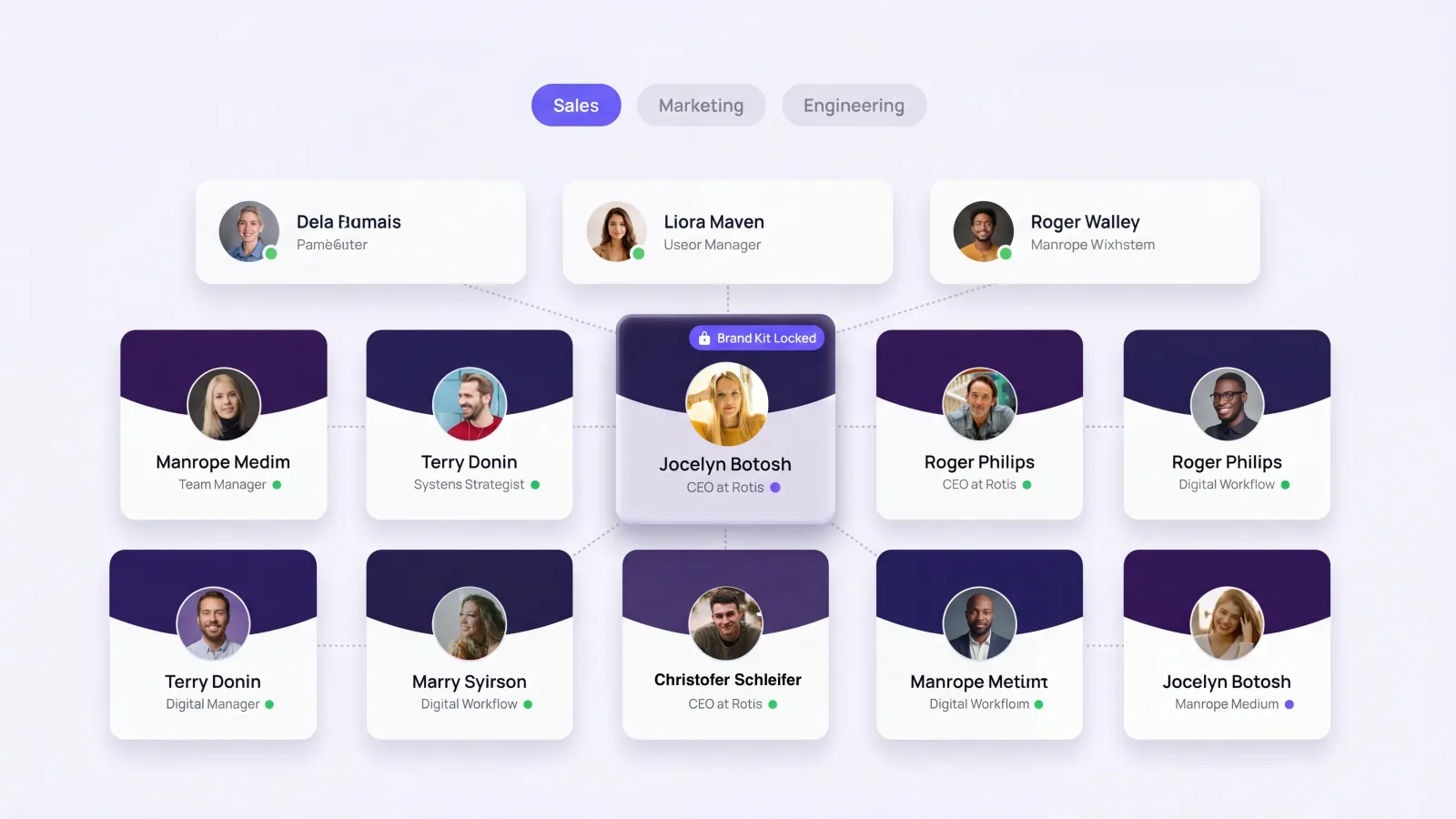
Every employee has their own digital business card, generated from their own profile but operating inside a shared system. The profile holds their name, role, contact details, photo, and any links the team allows. The system provides one canonical place where any update flows through to every share method—NFC, QR, email signature, profile URL, embedded preview.
This sounds basic. The leverage comes from what it makes possible upstream and downstream.
Brand Kit Inheritance
The marketing team defines the brand kit once: logo, colors, typography, layout. Every employee’s card inherits the kit by default. Individual reps can customize a controlled subset of fields (their own bio, their own portfolio links) but cannot accidentally drift the visual brand.
The practical effect is dramatic. A new logo is deployed by uploading it to the central admin once, and every employee’s card updates automatically. A coordinated rebrand that used to take three months of email reminders now takes ten minutes. (For the practical “what should the kit contain” checklist, see building a brand kit for your whole team’s cards.)
Field Policies and Lock Controls
Some fields should be editable by the employee (mobile number, social handles). Some should be read-only at the org level (job title—set by HR’s system of record), and some should be tightly controlled (legal entity, address, regulatory disclosures for industries like financial services).
A modern team-tier card platform supports these distinctions natively. Field-level lock controls prevent reps from accidentally publishing wrong or non-compliant information, while still preserving the personal touches that make individual cards feel authentic.
Department and Role-Based Visibility
Not every employee needs every feature. A receptionist’s card and a senior partner’s card serve different purposes. Department-aware permissions ensure that policies are tailored to context: which fields are visible, which are private, which require approval to change, which auto-populate from the HR system.
This is also where the underrated principle of most-specific-wins becomes useful. A field policy can be set at the org level, then overridden at the role level, then further refined at the department level. The system resolves the right policy automatically rather than asking each manager to reapply rules from scratch.
An Audit Log That Survives Personnel Changes
Every change to every card—by whom, from where, when—is recorded. This is the boring but indispensable feature that turns the system from a productivity tool into an enterprise-grade one. When a rep leaves, the audit log is the institutional record of what they shared with whom. When a regulator asks who accessed which record, the audit log is the answer.
Analytics Rolled Up to the Org Level
Individual rep analytics are interesting; team analytics are decision-grade. Org-level dashboards show how many cards are being shared, how many are being saved, how many are converting to meetings, which departments are most active, which events produced the highest yield. This is the data that lets a CRO or a head of marketing make resourcing decisions.
For the data to be useful, the underlying capture has to be consistent across the team—which is why the brand kit, field policies, and central directory matter as inputs. Without those, org-level analytics are just averaged noise.
The Migration Path
Most teams cannot transition overnight. The path that tends to succeed has four stages.
Stage 1: Inventory What Exists
Before deploying anything new, document what the current state actually is. How many people are currently exchanging cards on behalf of the company? Where do their contacts live? What does each rep’s current email signature look like? What logo, what color treatment, what disclaimer? The inventory is almost always more chaotic than leadership expects, and the inventory itself is often what produces the budget for the migration.
Stage 2: Define the Brand Kit and Field Policies
Marketing produces the brand kit: logo, primary and secondary colors, typography, default layout. Legal and HR define which fields are organization-controlled (titles, legal entity, regulatory disclosures), which are employee-controlled, and which are blocked. This decision lives in a single document; it gets translated later into platform configuration.
Stage 3: Pilot With a High-Engagement Team
Pick a single team—sales, partnerships, or business development—to deploy first. The team should be (a) high enough volume to produce real data within 4 to 6 weeks, and (b) motivated enough to give meaningful feedback. Roll out the platform with the brand kit and field policies in place, train on the use cases, and measure adoption.
The point of the pilot is not to validate that digital business cards work—they do—but to validate that the specific configuration of brand, fields, and CRM integration matches the team’s actual workflow. The cost of fixing this in a 10-person pilot is much lower than fixing it after rolling out to 200 people.
Stage 4: Roll Out and Sunset Legacy
Once the pilot has produced a configuration that works, expand to the rest of the customer-facing organization. The hardest part is sunsetting the old behavior—asking reps to stop printing the old card, change their email signature, retire the personal Excel file. The transition tends to require both top-down communication (this is now the standard) and bottom-up incentives (the new system makes the rep’s job easier in measurable ways).
Companies that try to skip the brand-kit and field-policy stages and just “roll out the tool” tend to end up with a slightly nicer-looking version of the chaos they started with. The configuration work is what produces the value.
What Gets Better, Concretely
The benefits of moving from spreadsheets to a managed networking platform tend to be observable within one quarter.
Brand Consistency Becomes Automatic
The next time marketing refreshes the visual identity, the deployment is hours rather than months. Every employee’s card, email signature, and digital touchpoint update in sync. Buyers notice the coherence even if they cannot articulate why.
Employee Transitions Become Lower-Friction
When an employee leaves, the company controls the underlying card profile. The departing employee’s personal contacts and personal relationships are theirs, but the company’s side of the record—who they talked to on behalf of the company, what was shared, what is in the pipeline—persists in the system. New hires can pick up cleanly because there is a structured record to inherit, not a spreadsheet from someone’s laptop.
Compliance Becomes Auditable Instead of Aspirational
The audit log answers the questions regulators ask. Field policies enforce the rules legal cares about. Captured contact data lives in a managed system with clear access controls and clear retention rules. The compliance posture moves from “we trust our employees” to “we have a system,” which is the answer most regulators are looking for.
Analytics Stop Being Anecdotal
The CRO can see, with confidence, how many leads the field organization captured at the conference last week, how many converted to meetings, and how that compares to last year. The marketing team can see which departments are getting the most use out of the brand kit and which need more enablement. The decisions that follow are based on data instead of folklore.
Pipeline Becomes More Continuous
The aggregate effect is a flatter conversion curve. Fewer dropped leads after events, faster follow-up, less institutional knowledge lost in transitions. None of these is a single dramatic win—but cumulatively, they are the difference between a sales organization that operates on individual heroics and one that operates as a system.
What Doesn’t Get Better, and What Goes Wrong
An honest accounting requires noting where the spreadsheet model still has advantages, and where the transition can fail.
Some Sales Cultures Resist Centralization
In organizations where senior reps treat their books of contacts as personal property, the move to a managed platform can produce real political resistance. The remedy is rarely technical—it is organizational. Senior leaders need to be visibly bought in, and the platform needs to demonstrably make individual reps’ jobs easier rather than harder.
Custom Data Models Stay Custom
If your sales motion involves industry-specific data fields—trading limits in financial services, accreditation in healthcare, security clearance in defense—the platform needs to accommodate them. Most do, but configuration takes time. Plan for at least one round of customization beyond the out-of-the-box defaults.
Integration Debt Is Real
Connecting the card platform to the CRM, the marketing automation system, the HR system, and any internal directories takes time. The integrations are usually well-documented, but every company’s combination is slightly unique, and the work is non-trivial. Budget for it explicitly.
Regional Privacy Variations
If the team operates in multiple privacy regimes—EU, UK, Brazil, California, India—the field policies, retention rules, and consent flows may need to vary by region. A good platform supports this; a bad one forces a lowest-common-denominator policy that frustrates everyone.
The Buying Criteria That Matter
If your organization is at the spreadsheet inflection point, here is the short list of capabilities that distinguish a tool that will scale from one that will need to be replaced in 18 months.
- Org-level admin with role-based access control. Multiple admin roles, audit logging, the ability to scope permissions by department or geography.
- Field policies with most-specific-wins resolution. Org-level defaults, role-level overrides, department-level refinements, and a clear way to inspect which policy is in effect for any given user.
- Brand kit inheritance with controlled customization. The brand is locked at the company level; individual fields are open at the user level.
- CRM and HR integrations. Two-way sync with at minimum your CRM, ideally with your HRIS for automatic profile creation and offboarding.
- Compliance posture. SOC 2 Type II at minimum. Data residency options if you operate in regions with localization requirements. Clear retention controls.
- Analytics that roll up cleanly. Per-rep, per-department, per-region views with comparable definitions across all dimensions.
- A managed offboarding flow. When an employee leaves, the system can transfer or archive their card data, retain audit history, and ensure no contact information is lost or unilaterally exported.
A platform like Lynqu’s B2B tier with its team management layer covers all of these as standard. The reason these specific capabilities matter is not that they are exotic; it is that without any one of them, the system breaks at the seam where it meets the rest of the company. (For sales-team-specific use cases, see how sales teams close more deals with digital business cards.)
When to Make the Move
Moving from informal individual networking to a managed team-level system is one of those changes that does not feel urgent until it is overdue. The signs that you have crossed the line: brand inconsistency you cannot fix in a single sprint, departing employees taking relationships with them, compliance questions you cannot answer, and analytics that are equal parts conjecture.
The good news is that the transition is no longer expensive or disruptive. A team-tier digital business card platform configured around a clear brand kit and clean field policies can replace the spreadsheet model in weeks rather than quarters. The compounding return is in everything that becomes possible afterward: faster rebrands, smoother employee transitions, defensible compliance, real analytics, and a coherent face to every prospect the team meets.
The companies that make this transition early tend to look, externally, more polished and more put-together than their actual size would suggest. That impression matters. It is one of the cheapest, most durable competitive advantages available to any growing organization.