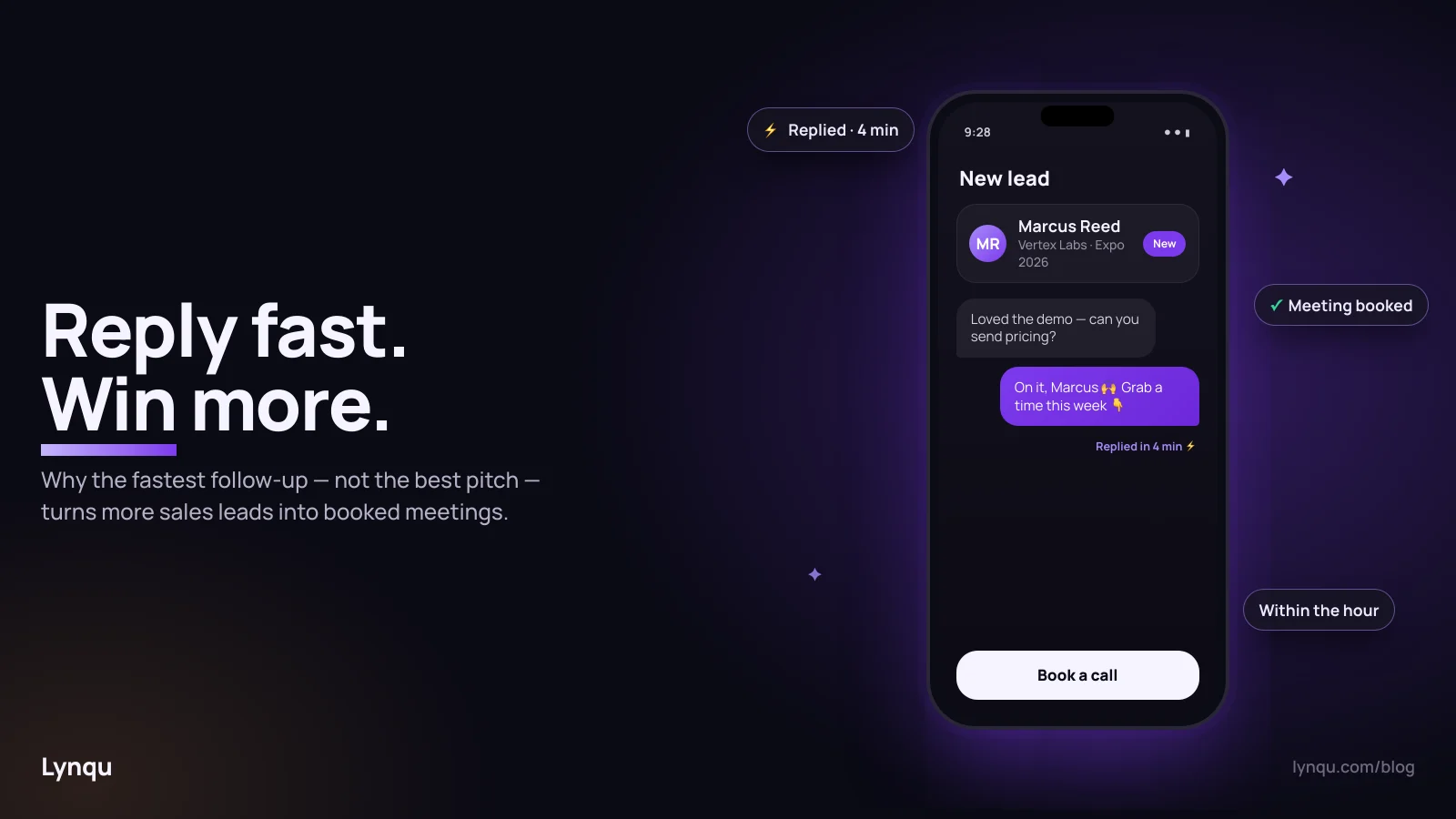
The fastest way to follow up with a sales lead is to remove every step between "the lead appears" and "the lead hears from you." That's the whole game. Most deals aren't lost to a better pitch — they're lost in the gap between a raised hand and a reply, while the lead's attention quietly moves on.
Speed is the rare sales lever that's both high-impact and almost free: you don't need a better script or a bigger team, just to stop letting fresh, interested leads cool. Here's how to actually be fast, the methods that hold up, and how fast "fast" needs to be.
Why does speed matter so much when following up with sales leads?
Because intent has a short shelf life. The moment someone fills in a form, scans your card, or asks "how does this work?" is the hottest that lead will ever be — and from there both their memory of you and their intent to act decay fast. A day later they're buried in their own work; a week later they barely remember reaching out.
The research backs the instinct: Harvard Business Review's well-known study on lead response found that companies contacting a web lead within an hour were dramatically more likely to qualify it than those who waited even a few hours, and far more again than those who let it sit a day. The point isn't a magic number — it's the shape of the curve: your odds fall off a cliff early. So speed isn't about looking eager; it's about catching the lead while they still care.
What's the fastest way to follow up with a sales lead?
In one line: capture the lead the instant you get it, get alerted in real time, send a pre-written first touch you personalize in seconds, and let them act in one tap. Each piece kills a delay — the lead never sits in your memory or an unchecked inbox, you're not writing from a blank page, and the lead can reply or book without hunting for your details.
Fast follow-up is mostly mechanics. The people who do it aren't more disciplined — they removed the steps in advance.
The fastest follow-up methods that actually work
Ranked by how quickly they get a real human exchange going:
- An instant auto-acknowledgment. A short automated "Got it — [Name] will be in touch within the hour" buys time and sets an expectation. Honest caveat: it's a placeholder, not the follow-up — it earns you minutes, it doesn't replace a person.
- A pre-written first touch you personalize in seconds. Draft 2–3 templates ahead of time (hot inbound, warm in-person, light nurture), then swap in one specific detail and send. Specific-and-fast beats polished-and-slow every time.
- Reply on the channel they already used. Don't make a lead switch context — someone who messaged on WhatsApp or scanned your card often replies faster to a text than a formal email. Match the channel to how you met.
- Real-time notification with a clear owner. Speed dies in shared inboxes where everyone assumes someone else has it. The moment a lead arrives, one named person should be pinged and own the first response.
- One-tap reconnect built into the message. A link to your digital card or calendar lets the lead act immediately, while they're still warm — instead of "I'll find time to reply" (they won't).
How fast is fast enough?
Match the speed to the heat of the lead:
- Hot inbound (demo request, pricing question): within minutes, ideally the same hour. This is where speed-to-lead wins or loses deals.
- Warm, met-in-person (event, meeting, card scan): within 24 hours, while you're still a vivid memory rather than a half-remembered name.
- Lighter / nurture: fast still helps, but consistency matters more than raw speed.
The trap is letting perfect kill fast. A message with one real detail sent now beats a beautifully crafted one sent in three days. Speed first, then specificity — never the reverse.
The mistake that makes "fast" impossible
Trying to be fast without preparation. If your plan is "I'll reply quickly when I get a minute," you've already lost: leads are scattered across a form tool, your phone, and paper cards (so just finding them takes longer than the lead will wait), every reply starts from a blank page, and nobody clearly owns the first response — so leads stall between "someone will handle that" and silence.
Fast follow-up isn't a personality trait. It's a small amount of setup — templates, capture, alerts, ownership — done before the leads arrive.
A quick example
Imagine a rep who lands a strong demo request plus five solid conversations in one afternoon at a trade show. The instinct is to "follow up back at my desk" — which means a week of catch-up, six contacts blurred into one memory, and only the most obvious lead ever hearing back.
Run it the fast way instead. Each conversation is captured on the spot with a one-line note and a hot/warm tag, and a notification flags the demo request immediately. Within the hour the rep sends a personalized first touch from a pre-written template — one specific detail each, a calendar link in every message. Six warm replies that evening instead of one the following week. Nothing clever happened; the leads just heard back while they still cared.
(Illustrative example for clarity, not a specific customer.)
Where a tool fits — and an honest caveat
This is exactly what a lead-capture and engagement platform like Lynqu is built for: capture each lead the instant you meet them (scan a card or share your digital one), keep the contact and context in one place with a clear owner, and reconnect in a tap — so the gap between "lead appears" and "lead hears from you" shrinks to minutes. You can start free.
Honest caveat: no tool makes a slow team fast on its own, and it won't write a genuine message for you. What it removes is the friction — the digging, the retyping, the "who's got this?" — so being fast becomes the easy default instead of a heroic effort. The judgment and the personal touch are still yours.
FAQ
What's the fastest way to follow up with a sales lead? Capture the lead instantly, get a real-time alert, send a pre-written first message that you personalize in seconds, and include a one-tap way to reconnect (a digital card or calendar link). The goal is to shrink the gap between when the lead appears and when they hear from you.
How quickly should you follow up with a sales lead? For hot inbound leads, within minutes — ideally the same hour, since your odds of qualifying drop sharply after that. For leads you met in person, within 24 hours while you're still a fresh, specific memory.
Does responding faster to leads really win more deals? Yes. Research on lead response times (including a widely cited Harvard Business Review study) consistently shows that contacting a lead within the first hour makes you far more likely to qualify it than waiting even a few hours. Intent and memory both decay quickly.
How can I follow up with leads faster without sounding generic? Prepare 2–3 first-touch templates in advance, then personalize each with one specific detail from your conversation. That requires capturing a quick note when you meet the lead — so speed and specificity work together instead of competing.
Why do fast follow-ups fail in practice? Usually because there was no prep: leads are scattered across tools and paper, every reply starts from a blank page, and no one clearly owns the first response. Fast follow-up is a system you set up beforehand, not willpower in the moment.